I got a recent email from my writer/publisher friend, GA, in California telling me about an award given to a mutual friend and former classmate of ours, Berkley Semple, for his first book of poetry, Lamplight Teller. Berkley's book just happened to be published through GA's company, WD Publishers, which makes the award doubly exciting. I just received a copy of it, and although some of the meaning was lost on me due to the strong references to his home country, Guyana, it's still a good read. Berkley is truly a gifted poet.
GA emailed me an actual copy of the award letter sent to Berkley confirming his receipt of the 2004 Guyana Prize for Literature. This very prestigious award is presented annually by the University of Guyana in various categories, and Berkley's book was declared the Best First Book of Poetry for 2004. He was flown down by the University to accept his award this past Monday, May 23, by His Excellency President Bharrat Jagdeo of Guyana.
Success is a beautiful thing. Congratulations again to Berkley, and to all the other writer/poets out there, keep on doing what your doing.
FYI: The WD Publisher's site is currently under reconstruction. When it's up and running again, I'll add a link to it in the sidebar. If you're interested in purchasing Lamplight Teller, it can be ordered directly from this address:
WD Publishers
P.O. Box 453
San Gabriel, CA 91778
or you can email them at gescomm@aol.com for more information.
Wednesday, May 25, 2005


Wednesday, May 18, 2005
The Apostrophe Rules!
In the Jennifer Garrett article, Eats, Blogs & Leaves (see May 11 post), there's a link to The Apostrophe Protection Society. I checked it out, and it's hard to believe someone would be so committed to the proper use of a single punctuation mark. I hadn't noticed, but it seems that the misuse of the apostrophe is at chronically epidemic proportions, particularly in blogs.
John Richards, retired journalist and Society chairman, breaks down every possible use of the "much abused" apostrophe in the English language, which I must admit, makes a strangely fascinating read. For those interested in improving their grammar in this area, this site's for you.
Even more surprising than finding this site, was learning there are other sites just like it, and other apostrophiles like Mr. Richards, so if you're a fan of the apostrophe, know that you're not alone.
Check out a recent post on the subject by Trudie, one of New Word's recent commenters and apostrophe advocate: Apostrophiles.
John Richards, retired journalist and Society chairman, breaks down every possible use of the "much abused" apostrophe in the English language, which I must admit, makes a strangely fascinating read. For those interested in improving their grammar in this area, this site's for you.
Even more surprising than finding this site, was learning there are other sites just like it, and other apostrophiles like Mr. Richards, so if you're a fan of the apostrophe, know that you're not alone.
Check out a recent post on the subject by Trudie, one of New Word's recent commenters and apostrophe advocate: Apostrophiles.
Good Book:
The LITTLE GUIDE TO YOUR WELL-READ LIFE
I've always been a terrible reader. I don't mean in ability, but in resolve and consistency. My commitment to literary pursuits has been sketchy at best; always well intended, but leaving so much to be desired.
It's not to say that I don't read, I read quite a bit actually; it's just WHAT I read that I've been concerned about. I've always been rabid about magazines, especially trade or specialty mags. Anything new that I wanted to learn, I'd find a magazine. (I've got so many of them they're running me out the house.) And I'm reading online all the time, which, according to one of my recent commenters, is the future of reading. (Although that's a comfort, it's a small one at best.)
I really should give myself more credit because I do own a lot of books. I've joined myriad book clubs over the years and have amassed a nice little library for myself, but it's mostly nonfiction, especially how-to books and manuals (mostly genre-specific topics like computers, photography, cooking, etc).
I never really got into "literature" (classic or otherwise); novels weren't really my thing, primarily because it takes me forever to read one. I'd start, then put it down for few days, then pick it back up, then put it down again. Sometimes I'd never finish it. Whenever I'd check a book out of the library I could never return it on time, which got expensive, so I stopped. (I'm sure I still owe one branch or another of the New York Public Library.)
Despite having the attention span of a flea (I totally attribute that to being born in the GenX TV era), I always had the desire to just sit and read a book from cover to cover within a reasonable amount of time.
What I came to learn, through a great book called The Little Guide to Your Well-Read Life by Steve Leveen, is that it's not just about knowing how to read, it's about knowing HOW to read. There's a way to appreciate literature that's nothing like your old high school English teacher or those LIT 101 classes in college would have you believe. You can tailor your reading to your own likes and lifestyle.
 I discovered this book in the Levenger catalog, where Steve Leveen is CEO and co-founder. (See previous post, Every Home Should Have One.) It's a small book, but loaded with just the right information for a recovering litphobe like me. Mr. Leveen even let me know that it was OK to not be into all the classics if they didn't move me, and that the way I've been reading all these years was just fine. Ultimately, it's about creating MY well-read life, not just being a well-read person.
One of the reasons I started this blog was to help myself become a better reader. Now that I've discovered The Little Guide… I know I'm on my way.
It's not to say that I don't read, I read quite a bit actually; it's just WHAT I read that I've been concerned about. I've always been rabid about magazines, especially trade or specialty mags. Anything new that I wanted to learn, I'd find a magazine. (I've got so many of them they're running me out the house.) And I'm reading online all the time, which, according to one of my recent commenters, is the future of reading. (Although that's a comfort, it's a small one at best.)
I really should give myself more credit because I do own a lot of books. I've joined myriad book clubs over the years and have amassed a nice little library for myself, but it's mostly nonfiction, especially how-to books and manuals (mostly genre-specific topics like computers, photography, cooking, etc).
I never really got into "literature" (classic or otherwise); novels weren't really my thing, primarily because it takes me forever to read one. I'd start, then put it down for few days, then pick it back up, then put it down again. Sometimes I'd never finish it. Whenever I'd check a book out of the library I could never return it on time, which got expensive, so I stopped. (I'm sure I still owe one branch or another of the New York Public Library.)
Despite having the attention span of a flea (I totally attribute that to being born in the GenX TV era), I always had the desire to just sit and read a book from cover to cover within a reasonable amount of time.
What I came to learn, through a great book called The Little Guide to Your Well-Read Life by Steve Leveen, is that it's not just about knowing how to read, it's about knowing HOW to read. There's a way to appreciate literature that's nothing like your old high school English teacher or those LIT 101 classes in college would have you believe. You can tailor your reading to your own likes and lifestyle.
 I discovered this book in the Levenger catalog, where Steve Leveen is CEO and co-founder. (See previous post, Every Home Should Have One.) It's a small book, but loaded with just the right information for a recovering litphobe like me. Mr. Leveen even let me know that it was OK to not be into all the classics if they didn't move me, and that the way I've been reading all these years was just fine. Ultimately, it's about creating MY well-read life, not just being a well-read person.
One of the reasons I started this blog was to help myself become a better reader. Now that I've discovered The Little Guide… I know I'm on my way.
Wednesday, May 11, 2005
Grammar's Still Important
In reading through Blogger Knowledge the other day, I came across an article entitled Eats, Blogs & Leaves by self-proclaimed "grammar bitch," Jennifer Garrett, that I believe every blogger (or anyone else writing online) should read. People have become increasingly lazy about grammar and punctuation in their online correspondences, and according to Ms. Garrett, it's time for a change. Beyond just being anal, it's just the right thing to do.
The article (and its title) is based on a book called Eats, Shoots & Leaves: The Zero Tolerance Approach to Punctuation by British writer Lynne Truss, which speaks to this very important topic.
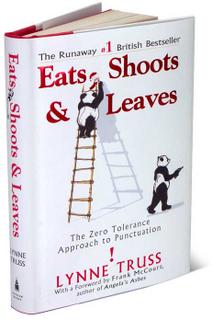 A #1 bestseller in the U.K., this small book offers a fun and historical look at punctuation usage in both America and the U.K. As a bit of a grammar geek myself I look forward to reading and learning from this book. (If it means anything, Amazon reviewers gave it 4 stars.)
Granted, there are those who "murder the king's English" (as my mother would say) as a matter of style or expression, then there are others who are too illiterate to know better, or those for whom English is a second language, then there are those who really just don't give a damn (the most dangerous). I guess it takes all kinds.
Call me crazy, but I just find it easier, and more satisfying, to read something that's written—and punctuated—well.
The article (and its title) is based on a book called Eats, Shoots & Leaves: The Zero Tolerance Approach to Punctuation by British writer Lynne Truss, which speaks to this very important topic.
 A #1 bestseller in the U.K., this small book offers a fun and historical look at punctuation usage in both America and the U.K. As a bit of a grammar geek myself I look forward to reading and learning from this book. (If it means anything, Amazon reviewers gave it 4 stars.)
Granted, there are those who "murder the king's English" (as my mother would say) as a matter of style or expression, then there are others who are too illiterate to know better, or those for whom English is a second language, then there are those who really just don't give a damn (the most dangerous). I guess it takes all kinds.
Call me crazy, but I just find it easier, and more satisfying, to read something that's written—and punctuated—well.
Every Home Should Have One
I was telling my friend Linda about this blog and she pulled out a catalog I hadn't seen in a while but always loved. It's called Levenger. Just looking at it again got me all excited because everything in there is for the "serious" reader. From journals and pens, to organizers and furniture, it's got it all!
Check out their website. There are links to it above and in the sidebar.
Check out their website. There are links to it above and in the sidebar.
Wednesday, May 04, 2005
Oprah To The Rescue?

An article in the New York Daily News a couple weeks back told of a group of writers begging Oprah Winfrey to feature contemporary (aka "living") writers in her book club again, saying that sales of contemporary fiction have fallen steadily because 1) people aren't reading as much, 2) the ones that do aren't being made aware of what's out there, and 3) Oprah's Book Club started featuring classic fiction works instead of new ones.
About 150+ writers signed an open letter from an association called Word of Mouth thanking Oprah for her help in championing the literary cause through her televised book club, and seeking her help in continuing it where new works are concerned. Signers included new and award-winning writers such as Amy Tan, M.J. Rose, and Maureen Howard.
Can Oprah singlehandedly save the literary world? I don't know. But as they say, the numbers ($) don't lie. What do you think? Read the letter and post your comments on Word Of Mouth's site. A link to Oprah's Book Club is listed in the sidebar.
Find Your Voice
I recently checked out a blog by a woman named Lorianne, a writer and college professor who commented on New Word a while back (see From Book To Screen: The Color Purple). It's called Dr. D's Teaching Blog. She set it up as part of the Expository Writing course she teaches at Keene State College.
One of her posts speaks about finding your voice as a writer. Although the focus is on blog writing, it really speaks to any kind of writing as we are the source of our own words. It really touched me because that's the journey I've been on for a while now as a would-be writer, and most recently as a blogger, and I thought it could be of help to anyone who wants to start writing or improve their writing.
Although she wrote this for her students, it would be interesting to do the exercises just for fun, especially if you have some writer/blogger friends. It's always great to learn something new. If you don't want to include others, you might want to skip the last part, or just make notes to yourself.
Lorianne's been kind enough to allow me to reprint that entry here, so read, enjoy, and find your voice.
Also, check out Lorianne's personal blog, Hoarded Ordinaries.
One of her posts speaks about finding your voice as a writer. Although the focus is on blog writing, it really speaks to any kind of writing as we are the source of our own words. It really touched me because that's the journey I've been on for a while now as a would-be writer, and most recently as a blogger, and I thought it could be of help to anyone who wants to start writing or improve their writing.
Although she wrote this for her students, it would be interesting to do the exercises just for fun, especially if you have some writer/blogger friends. It's always great to learn something new. If you don't want to include others, you might want to skip the last part, or just make notes to yourself.
Lorianne's been kind enough to allow me to reprint that entry here, so read, enjoy, and find your voice.
Also, check out Lorianne's personal blog, Hoarded Ordinaries.
FINDING VOICE IN SOMEONE ELSE'S WRITING
by Lorianne DiSabato
"Voice" is the intangible personality or presence that gives power to a piece of writing. Voice is what makes your writing sound like "you" and no one else, and it is the quality or tone that either grabs a reader's attention or leaves a reader cold. Writing without voice sounds dry and detached; writing with voice sounds alive and engaging as if the words themselves have reached out and touched you.One way to find your own voice is by writing frequently: this is one of the potential benefits of blogging. By writing (and sharing your writing) frequently, you can, over time, discover the "true voice" that lurks behind your words.
Detecting your own voice, however, can be difficult. We're sometimes too close to our writing to judge it objectively, and we sometimes can't tell whether a particular piece will speak powerfully to readers. This is why getting feedback on our writing is so helpful. Often our readers can find our voice more accurately than we ourselves can.
To help you find your blogging voice, read someone else's ENTIRE blog from the most recent posts to the very first one. (To do this, you'll have to use the archive links in the blog's sidebar.) As you're reading, right-click and open in a new window the permalink to a handful of entries (between 1 and 3) that you think demonstrate the strongest voice. In other words, as you are reading, make note of
- the blog's best entry
- the blog's most powerful entry
- the blog's most genuine or "real" entry
When you've determined (and right-clicked) the handful of entries you think are the best, most powerful, or most "real," post a comment on the blog's MOST RECENT entry. In this comment, copy and paste the permalinks to the handful of entries you selected, and tell the writer why you think these entries are particularly noteworthy. Then, I want you to tell the writer how you would describe their voice: what sort of authorial tone or "personality" do they present to their readers? (For example, do they have a humorous voice, a trustworthy voice, a sarcastic voice, a witty voice, a confessional voice, a conversational voice, etc.)
Wednesday, April 27, 2005
Good Book: The POET'S COMPANION
I've been dabbling in poetry writing for about a year-and-change now. I don't write very often, mostly when the feeling hits, but I'd like to write more. One of the problems I've had is that I never really learned "how" to write poetry. I never read a book, took a class, or attended a seminar. I've read some poetry, and have had friends who were poets, and even used to go to poetry readings when I produced my public access poetry show, WORDS!, to recruit poets and get inspiration, but I never really felt confident about myself as a poet.
I actually started out trying to write song lyrics, which is quite different from what I'd call "serious" poetry. Lyrics have their own thing to them in that they have to fit whatever music they're attached to. You can't fall too in love with what you do because it's bound to change somehow. I have yet to put any of my words to music, but I'm looking forward to it.
I made my first attempt at "real" poetry, when I was going through some emotional drama-trauma about a year or so ago. One day I just started writing. I have to say the stuff was pretty dark, and not all that great, but it helped exorcise some pretty nasty feelings I had at the time. It was a start. Since then, I've continued to dabble from time to time. The problem, like I said before, is that I didn't really know "how" to write. Enter The Poet's Companion.
 The Poet's Companion (by poets Kim Addonizio and Dorianne Laux) is a book I've had for a while now, but never read past the first few pages. I got it from a book club I belonged to a couple years ago. I only now decided to read it, and so far, so good; I'm almost done with the first section. I know that's not very much to comment on, but it's enough for me to know I'd like to finish it. There are lots of cool exercises in them that I believe will help me a lot with my writing. I really look forward to continuing it.
From what I've read so far, I'd recommend it highly.
I actually started out trying to write song lyrics, which is quite different from what I'd call "serious" poetry. Lyrics have their own thing to them in that they have to fit whatever music they're attached to. You can't fall too in love with what you do because it's bound to change somehow. I have yet to put any of my words to music, but I'm looking forward to it.
I made my first attempt at "real" poetry, when I was going through some emotional drama-trauma about a year or so ago. One day I just started writing. I have to say the stuff was pretty dark, and not all that great, but it helped exorcise some pretty nasty feelings I had at the time. It was a start. Since then, I've continued to dabble from time to time. The problem, like I said before, is that I didn't really know "how" to write. Enter The Poet's Companion.
 The Poet's Companion (by poets Kim Addonizio and Dorianne Laux) is a book I've had for a while now, but never read past the first few pages. I got it from a book club I belonged to a couple years ago. I only now decided to read it, and so far, so good; I'm almost done with the first section. I know that's not very much to comment on, but it's enough for me to know I'd like to finish it. There are lots of cool exercises in them that I believe will help me a lot with my writing. I really look forward to continuing it.
From what I've read so far, I'd recommend it highly.
Wednesday, April 20, 2005
Morning Pages? Try It!
I've been journaling for a few years now, and have really taken to the concept of "morning pages." I got the idea from the book, The Artist's Way, by Julia Cameron, which was introduced to me by a friend. Morning pages are three pages (could be more, but no less) of longhand writing done first thing each morning about nothing in particular; just write whatever is in your head. According to Ms. Cameron, "they might also, more ingloriously, be called brain drain, since that is one of their main functions."
As creative people (and we all are) we often get blocked by our own fears and insecurities, or those imposed on us by others. We are often unable to move past it and forever live with the frustration of never being able to fully express ourselves in a creative way. This is particularly maddening for those of us who create for a living. As writers, fine artists, or filmmakers, we depend on our ability to tap into the creative flow whenever we need it, but at times we just can't. Opening ourselves up to the process of morning pages can help release whatever is holding us back so we can continue to do what we do best—create.
I recently came across a blog called inkmusings, where it's author, Gary Varner, talked about his experience with morning pages. Here is a reprint of that post given with Gary's blessing. Enjoy.
As creative people (and we all are) we often get blocked by our own fears and insecurities, or those imposed on us by others. We are often unable to move past it and forever live with the frustration of never being able to fully express ourselves in a creative way. This is particularly maddening for those of us who create for a living. As writers, fine artists, or filmmakers, we depend on our ability to tap into the creative flow whenever we need it, but at times we just can't. Opening ourselves up to the process of morning pages can help release whatever is holding us back so we can continue to do what we do best—create.
I recently came across a blog called inkmusings, where it's author, Gary Varner, talked about his experience with morning pages. Here is a reprint of that post given with Gary's blessing. Enjoy.
MORNING PAGES
by Gary Varner
This morning I embraced an old friend: morning journal pages.Last year when I was struggling in the process of moving out of a relationship and wondering what the hell had happened to my body, one source of solace was the times I spent at Starbucks, writing in my journal with the dawn breaking in the distance. Most days such writing equated to little more than time spent atop a glorious pity-pot, but sometimes in these attempts at cheap therapy, enough epiphanies appeared and made a difference.
Recently while trying to focus more heavily on writing for income, I realized I’ve been neglecting these me-moments a lot, and I missed them. So this morning, much to the grumpy machinations of my really-rather-sleep-another-hour body, I headed off to my favorite early morning Starbucks and renewed this old tradition.
Why morning pages? Many writers use this vehicle to jump-start their day, even though they still spend much of the day writing on other, hopefully profitable pursuits. Writing toss-away pages early in the day simply clears your mind of the clutter and noise accumulated overnight. Like a short meditative sit or a brief power nap, morning pages rejuvenate and result in a clearer state of mind.
Today I chose a target of three pages written in my Moleskine, which takes about 20 minutes, a time that’s highly manageable. Other writers I know write much more, and at times I’ve written 10 or 12 pages when there were things that needed outing, but the real point is in setting a minimum page count and not stop until said pages are filled. It’s also a good idea to force yourself to keep the hand moving as well. Morning pages are not a time for pondering then pontificating between the lines: the whole point is to unclutter and attain clear thinking, and distractions festered by inactivity don’t further that cause.
Will I continue morning pages? One day does not a habit make (but yards of black cloth can make several!...sorry…bad – but funny – pun!), but it’s a start and with memories of the positive effect morning pages once had during a rough time I should be motivated enough to set this good habit once again.
Photo credit: © Gary Varner

Wednesday, April 13, 2005
Still Too Much?
This William Wordsworth poem was submitted to me for another site of mine for Poetry Month. It's interesting how the sentiment still holds two centuries later. Sad but true.
THE WORLD IS TOO MUCH WITH US (1807)
by William Wordsworth

The world is too much with us; late and soon,
Getting and spending, we lay waste our powers:
Little we see in Nature that is ours;
We have given our hearts away, a sordid boon!
This Sea that bares her bosom to the moon,
The winds that will be howling at all hours,
And are up-gathered now like sleeping flowers,
For this, for everything, we are out of tune;
It moves us not.--Great God! I'd rather be
A Pagan suckled in a creed outworn;
So might I, standing on this pleasant lea,
Have glimpses that would make me less forlorn;
Have sight of Proteus rising from the sea;
Or hear Tritorn blow his wreathed horn.
Check the sidebar for more on William Wordsworth.
THE WORLD IS TOO MUCH WITH US (1807)
by William Wordsworth
The world is too much with us; late and soon,
Getting and spending, we lay waste our powers:
Little we see in Nature that is ours;
We have given our hearts away, a sordid boon!
This Sea that bares her bosom to the moon,
The winds that will be howling at all hours,
And are up-gathered now like sleeping flowers,
For this, for everything, we are out of tune;
It moves us not.--Great God! I'd rather be
A Pagan suckled in a creed outworn;
So might I, standing on this pleasant lea,
Have glimpses that would make me less forlorn;
Have sight of Proteus rising from the sea;
Or hear Tritorn blow his wreathed horn.
Check the sidebar for more on William Wordsworth.
Tuesday, April 12, 2005
Who's The Screenwriter?
Tried to find some info on The Color Purple screenwriter, Menno Meyjes, but could only find links to his filmography. There's one on the IMDb link I included in the sidebar (The Color Purple), and I'll add one here from the New York Times.
Menno Meyjes (filmography)
From Book To Screen: The COLOR PURPLE
In addition to other books and writers, I'll be paying particular attention to books that have been made into films. Though some are done better than others, it's always interesting to see how screenwriters adapt books to fit the silver screen. There have been so many cinematic adaptations of books, it's hard to know which one to look at first.

The first book to pop into my head was The Color Purple by Alice Walker. Who can forget the scene where Celie finally reunites with her sister, Nettie (Kleenex anyone?), or when Sophia confronts Celie about telling Harpo to beat her? (Did Oprah work that or what?)
It's been over 20 years since this small, but powerful, book was published (1983), and 2005 marks the 20th anniversary of the film's release. For this reason, and others, I figured it would be great to give them both another look.
I saw the movie again only a few months ago, but it's been about 10 years (if not longer) since I read the book, so I'll be reading it once more as well. I'll probably watch the film again too, just because. In my humble opinion, everyone attached to that film should have gotten an Oscar. They wuz robbed!
Check for related links to this and all featured books/films in the sidebar, and a link to the CliffsNotes site below for a comprehensive overview of the book:
CliffsNotes: The COLOR PURPLE
Life Is Fine
This is a poem by Langston Hughes that I included on one of my other sites for Poetry Month. To learn more about Langston Hughes, check out the link above or in the sidebar.
LIFE IS FINE
by Langston Hughes

I went down to the river,
I set down on the bank.
I tried to think but couldn't,
So I jumped in and sank.
I came up once and hollered!
I came up twice and cried!
If that water hadn't a-been so cold
I might've sunk and died.
But it was … Cold in that water! … It was cold!
I took the elevator
Sixteen floors above the ground.
I thought about my baby
And thought I would jump down.
I stood there and I hollered!
I stood there and I cried!
If it hadn't a-been so high
I might've jumped and died.
But it was … High up there! … It was high!
So since I'm still here livin',
I guess I will live on.
I could've died for love—
But for livin' I was born
Though you may hear me holler,
And you may see me cry—
I'll be dogged, sweet baby,
If you gonna see me die.
Life is fine! … Fine as wine! … Life is fine!
From "The Collected Poems of Langston Hughes," published by Alfred A. Knopf, Inc.
Copyright ©1994 The Estate of Langston Hughes.
LIFE IS FINE
by Langston Hughes
I went down to the river,
I set down on the bank.
I tried to think but couldn't,
So I jumped in and sank.
I came up once and hollered!
I came up twice and cried!
If that water hadn't a-been so cold
I might've sunk and died.
But it was … Cold in that water! … It was cold!
I took the elevator
Sixteen floors above the ground.
I thought about my baby
And thought I would jump down.
I stood there and I hollered!
I stood there and I cried!
If it hadn't a-been so high
I might've jumped and died.
But it was … High up there! … It was high!
So since I'm still here livin',
I guess I will live on.
I could've died for love—
But for livin' I was born
Though you may hear me holler,
And you may see me cry—
I'll be dogged, sweet baby,
If you gonna see me die.
Life is fine! … Fine as wine! … Life is fine!
From "The Collected Poems of Langston Hughes," published by Alfred A. Knopf, Inc.
Copyright ©1994 The Estate of Langston Hughes.
Monday, April 11, 2005
If You Want To Write…WRITE!
Here's a poem I wrote last year (one of my first). This is to encourage anyone who feels like they want to write to just sit down and do it.
JUST WRITE
by Melanie Morgan
I want to write about life—
Life in general, but mine in particular.
I want to write poems and songs and books and movies
Stupid and sweet, profound and profane.
I want to write important things and trivial shit
About what color to paint my room—or my hair.
I want to write about world peace
And how to be at peace in a world
Where there’s no justice nor peace.
I want to write something everyone wants to read
But won’t be able to because they won’t know it exists.
I want to write a memoir chronicling a life
Well-lived, well-loved, and well-sexed.
I want to write about all the stuff I did
And the stuff I didn’t do but always wanted to do.
I want to write a bunch of nonsensical stuff
That makes all the sense in the world.
I want to write about yesterday, today, and the hereafter
When it’s supposed to be over but really isn’t.
I want to write about what I believe in,
Even if it’s absolutely nothing.
I want to write about my hopes and dreams and desires,
Even if they’re nothing more than fantasy.
I want to write more
And could say a lot less,
So let me put the pen down and just write.
© 2004 Melanie Morgan
JUST WRITE
by Melanie Morgan
I want to write about life—
Life in general, but mine in particular.
I want to write poems and songs and books and movies
Stupid and sweet, profound and profane.
I want to write important things and trivial shit
About what color to paint my room—or my hair.
I want to write about world peace
And how to be at peace in a world
Where there’s no justice nor peace.
I want to write something everyone wants to read
But won’t be able to because they won’t know it exists.
I want to write a memoir chronicling a life
Well-lived, well-loved, and well-sexed.
I want to write about all the stuff I did
And the stuff I didn’t do but always wanted to do.
I want to write a bunch of nonsensical stuff
That makes all the sense in the world.
I want to write about yesterday, today, and the hereafter
When it’s supposed to be over but really isn’t.
I want to write about what I believe in,
Even if it’s absolutely nothing.
I want to write about my hopes and dreams and desires,
Even if they’re nothing more than fantasy.
I want to write more
And could say a lot less,
So let me put the pen down and just write.
© 2004 Melanie Morgan
Celebrate POETRY MONTH

For those who don't know, and to remind those who do, April is National Poetry Month. Acknowledging it is as good a way as any to kick off this blog.
Throughout the month I'll be adding links to poetry sites, providing poetry info, and posting poems from myself and others. I'll also be adding links to sites of literary interest.
To learn more about NATIONAL POETRY MONTH click here:
Sunday, April 10, 2005
WELCOME!
This is the home of the literary blogzine, New Word. I've always wanted to create a literary magazine, but was put off by the cost of producing it in print. When I discovered blogging recently, I resurrected the idea and here it is!
The weblog format lends itself beautifully, as it allows for content and commentary from myself and others, and the cost of producing it will be within reason.
As New Word grows, it should be a source of information and inspiration for those reading it, and a creative outlet for those featured on it. As editor, I'm looking forward to finding out as much as I can and presenting it.
The weblog format lends itself beautifully, as it allows for content and commentary from myself and others, and the cost of producing it will be within reason.
As New Word grows, it should be a source of information and inspiration for those reading it, and a creative outlet for those featured on it. As editor, I'm looking forward to finding out as much as I can and presenting it.
Subscribe to:
Posts (Atom)